Motor precision
Efficiency, smoothness, steadiness, acceleration, and unnecessary motion.

Efficiency, smoothness, steadiness, acceleration, and unnecessary motion.
Tool–tissue interaction, manipulation, tension, and procedure-specific technique.
Steps, timing, procedural checkpoints, corrections, and intermediate states.
Closure quality, symmetry, spacing, and other procedure-specific result measures.
Each recorded procedure becomes structured performance data — a learning loop that helps the next surgeon improve.

Collect procedure video, motion, steps, tool interaction, annotations, and outcome artifacts.

Identify phases, actions, technique, corrections, intermediate states, and execution patterns.

Compare performance against expert examples, reference ranges, and procedure-specific criteria.

Surface the moments that matter, giving surgeons targeted feedback and measurable progress.
FinePoint combines a standardized practice environment, surgeon-facing software, AI measurement, expert input, and analytics — so performance can be measured without adding manual review work.
Needle loading and corrections around the 4–5 o'clock segment contributed most to excess motion. Practice this segment first.
Procedure capture, practice libraries, session review, and focused feedback.

Procedure-specific practice outside the OR on standardized physical models.

Individual progress, cohort analytics, benchmark views, and shared intelligence.
Domain models trained on surgical data and expert input to measure execution.

Surgeon review and expert input continuously refine the performance benchmark.
Each procedure contributes to a growing body of structured performance data — making surgical expertise easier to learn from, compare, and apply.
Learn from expert procedures, focus practice where it matters, prepare for challenging cases, and review performance afterward.
Use structured procedural data to understand how devices and procedures are used, improve training, and evaluate performance.

Foundational work behind FinePoint is being developed through an NIH-funded STTR project awarded to Gravitate AI, with Brigham and Women's Hospital as the clinical research partner.
Measuring movement quality, consistency, retries, and outcomes across repeated surgical practice.

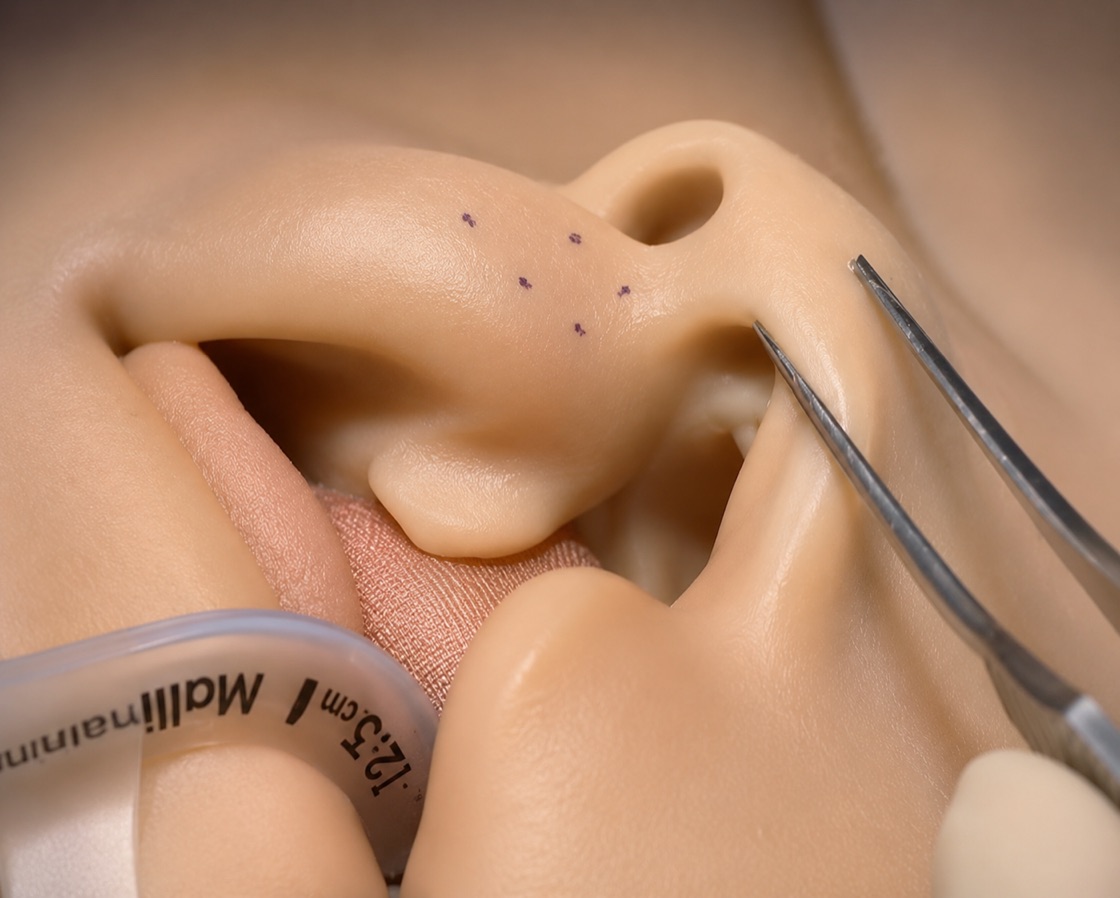
Extending FinePoint from suturing into multi-step cleft repair — measuring marking, dissection, procedural sequence, closure, tool–tissue interaction, and final symmetry.
FinePoint partners with surgical programs and MedTech to define a procedure, capture expert performance, build the benchmark, and deploy measurable feedback.